James Bond Cars – Part 1

The following is a great little montage showing some of the cool vehicles that James Bond has driven over the 24 films in the series.

This got the RedlineNorth Team thinking about some of their favourite vehicles from the series and we’ve decided to profile a few.

Lotus Esprit S1 – The Spy Who Loved Me (1977)

Lotus Esprit – The Spy Who Loved Me (1977)

First up the Lotus Esprit. Who can forget the underwater scene from the Spy Who Loved Me where James Bond’s white Lotus Esprit converts into submarine mode after driving off a dock into the water. There is also the classic scene with the car ‘driving’ in from the ocean onto a crowded beach – much to the amazement of beach goers.

The Esprit in the film was fully equipped with anti-aircraft missiles, depth chargers and could deploy black ink under water to foil enemy pursuers.

Two Lotus Esprits were loaned to the production company for filming. One was actually turned into a functional submarine. Once the movie was released they became so popular that there was supposedly a three year waiting list to purchase one.

The Esprit S1 (1976) had a 4 cylinder, 2.0L engine that produce 160 hp. Lotus claimed the Esprit could do 0-60 mph in 6.8 seconds and had a top speed of 138 mph (222 km/h).

Aston Martin DB5

Aston Martin DB5 – Goldfinger (1964)

First debuting in Gold Finger (1964) but also appearing in Thunderball, GoldenEye, and a small appearance in Tomorrow Never Dies, and Casino Royale, the Aston Martin DB5 is the quintessential Bond vehicle.

The car was equipped with machine guns behind the front indicators, a bullet shield behind the rear window and a revolving licence plate that switched between a number of different plates. It was also capable of deploying a smoke screen and an oil slick to foil unwitting enemies, and of course a little red button that deployed the passenger ejector seat!

The original Goldfinger DB5 with gadgets was sold on October 27, 2010 for $4.1m (£2.6m). For a more reasonable price a scaled down electric model of the Goldfinger DB5 can be had for £48.

AMC Hornet

AMC Hornet – The Man with the Gold Gun (1974)

The American Motors Corporation (AMC) Hornet had its Bond debut in the 1974 film The Man With The Golden Gun. The V8, 175 hp Hornet is best remembered for the corkscrew jump over a river during during a car chase scene. A specially modified version of the car which had a lower stance and larger wheel wells was used by an uncredited British stuntman Loren “Bumps” Willert for the stunt. The jump distance was approximately 16 meters (52 ft) and the jump off speed was 65 kph (40 mph).

The original Hornet is still on display at the National Motor Museum Beaulieu, England.

Up Next….Aston Martin V8 in Part 2.

Z-Fest

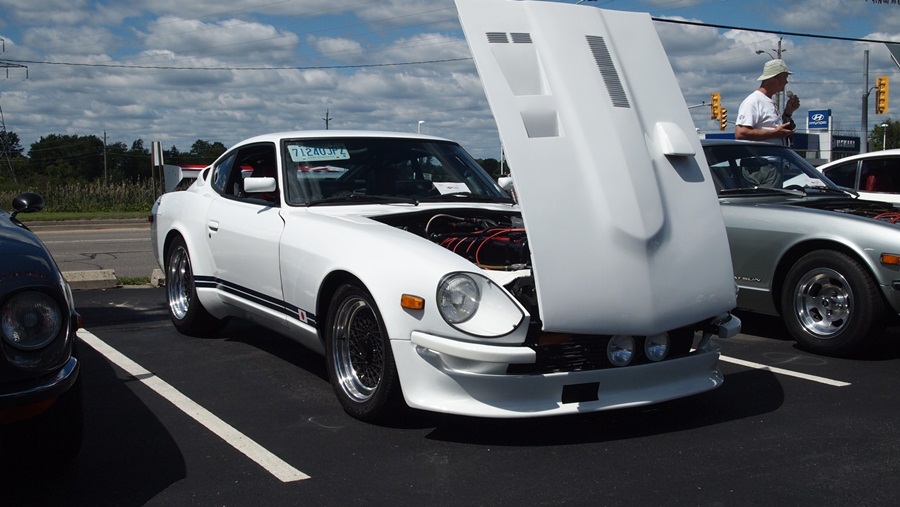
On Saturday August 18th, members of the Ontario Z-Cars Association brought their Nissan and Datsun vehicles to Brantford Nissan for the 18th annual Z-Fest. Its aim is to celebrate all Z-cars from the early Datsun models through to the current Nissan name plates.  The whole array of Z-cars (Fairlady Z in Japan) were present including the 240z, 260z, 280zx, 300zx both early and late versions, the 350z, and 370z not excluding the odd G series, GTR, and Skyline. One of our local correspondents kindly attended the day long event to capture Nissan’s unique history as the maker of Japan’s “Corvette” models.

Nissan 240z’s

Awards at Z-Fest are given to both stock and modified classes of cars.The show consisted mostly of early Datsuns, primarily 240z’s.

Nissan 260z

In contrast to all the modified 350s and 370s, most of the 240, 260, and 280 cars were stock with only minor personal touches.

Nissan 280zx

It was very inspiring to see the spotless, rust-free engine bays of these 30 year old cars.

Modified Nissan 240z

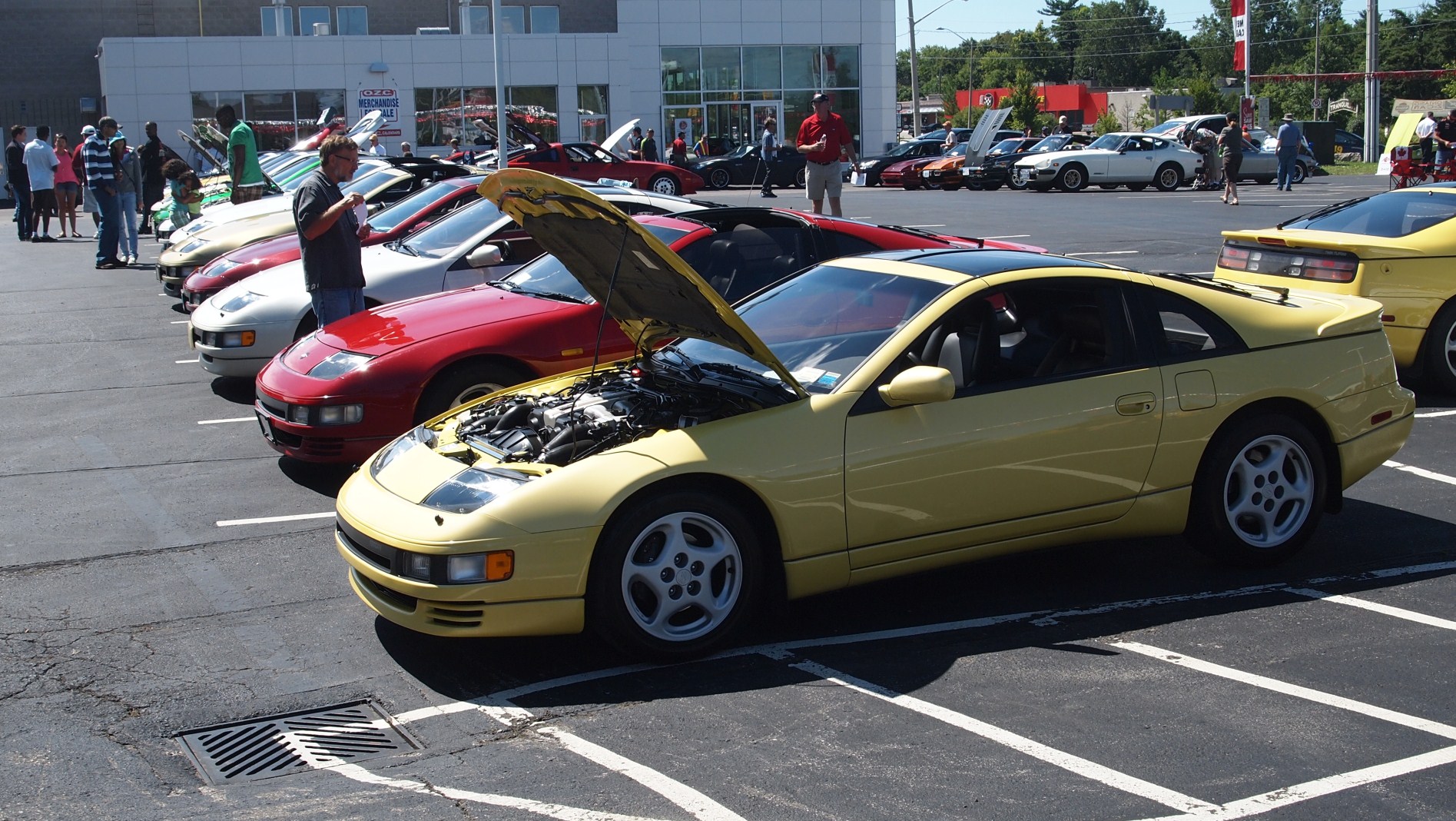
There was quite a poor showing of the Z31, the 1984-1989 version of the Nissan Z. And of the models that were present, most were stock and in fact, many were “Garage Queens” as their owners professed to how little they are actually driven. This would account for their stellar paint and unmolested interiors.

1985 Nissan 300zx

As always, there was a good showing of the 1990-1996 300zx. Although there were not as many heavily modified Z32s as in year’s past, there were many bone stock and very low mileage cars including a 30,000km 1990 model. The Z32 model provides a solid platform to create a variety of looks in regards to engine performance and exterior styling.

Nissan 300zx

Nissan 300zx

Modified Nissan 300zx

Having been equipped with a twin turbo system from the manufacturer, it is quite easy and relatively inexpensive to build up the 300zx engine to incredible power levels with the innovative parts targeted at the enthusiast.

Nissan 300zx z32 engine

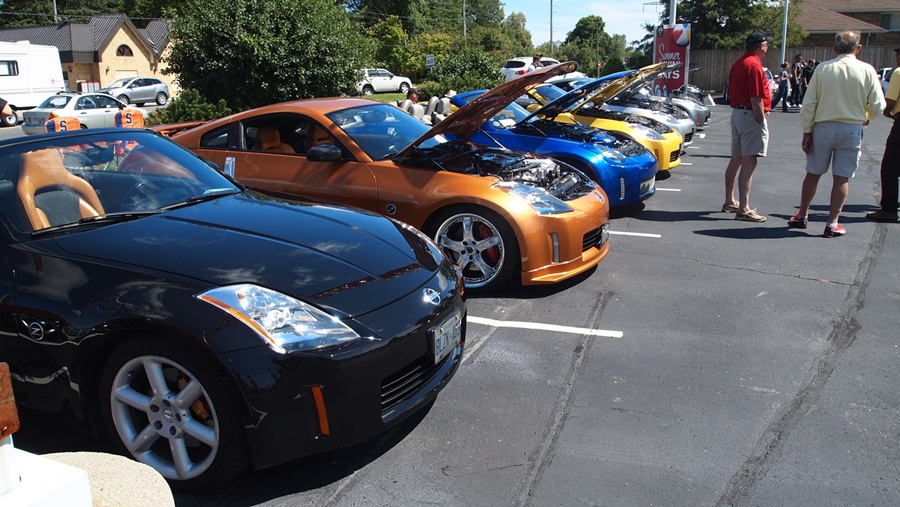
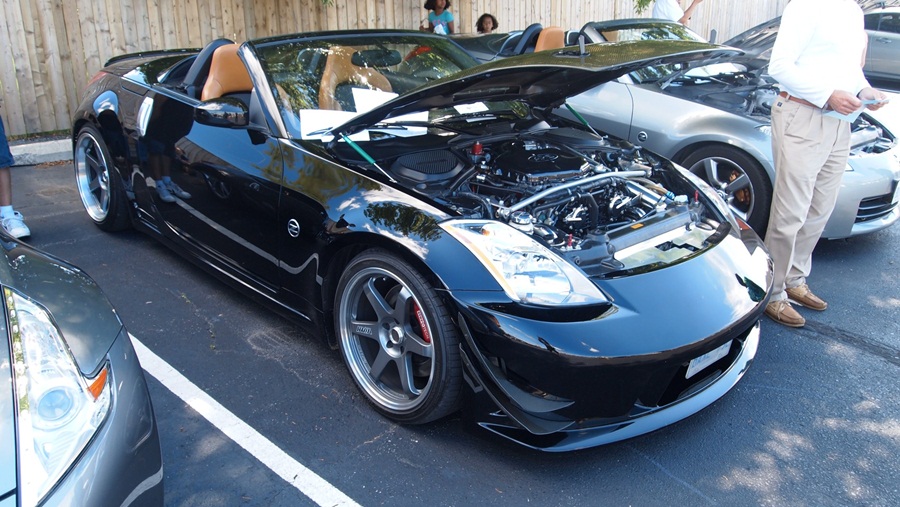
There seems to be more and more 350z’s and 370z’s on the road all the time, and this was evident at Z-Fest.  Although the 350z and 370z come standard with 287 hp and 332 hp respectively, their engines are non-aspirated.  However, many companies have since released turbo and/or supercharger kits to transform these models into true Japanese, fire-breathing dragons.

Nissan 350z’s

Nissan 370z convertible

With all the Nissan models parked side by side, it was easy to identify the 240z’s sleek and timeless lines. Originally introduced to the North American market in 1970, it truly was ahead of its time.  Similarly at the event, it also became apparent Nissan’s styling was not iconic during the late 70s and mid 80s. However, with the release of the Z32 in 1989, the Z-car lineage got its Mojo back with the rebirth of the iconic Z design which has been continued through to the current 350z, and 370z models.

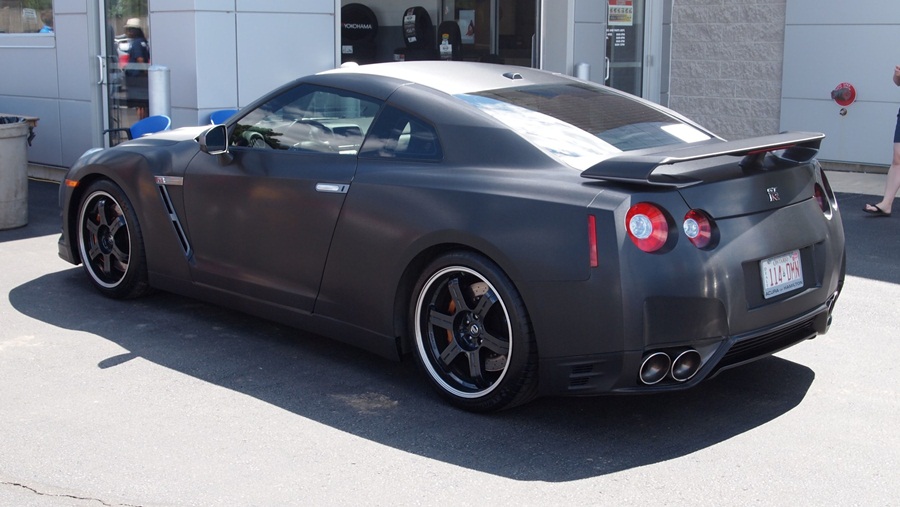
Today, Nissan has a new model which has been taking the sports car world by storm – the Nissan GTR also known as “Godzilla”. Built with the highest technological innovations available, the Nissan GTR is able to compete on the track with any of today’s supercars while only costing the price of a top of the line Corvette.

Nissan GTR

Make sure you check off next year’s date for the Z-Fest event as it is a must see for any Nissan enthusiast.

New Formula ‘E’ Racing Series Announced

News this week that FIA, the International Motorsport Federation, has announced a global series of city centre electric car races.  The objective of the series is to have 10 teams and 20 drivers participating in the competition and it will be open to any cars sanctioned as ‘Formula E’ by the FIA.

The commercial rights to the FIA Formula E Championship has been licensed to a consortium of investors, Formula E Holdings Ltd (FEH). FEH has as anchor investor London-based entrepreneur Enrique Bañuelos, and as CEO and shareholder former MEP and racing team owner Alejandro Agag.

Audi R18 e-tron quattro the first electric hybrid to win the 24 Hours of Le Mans

Demonstration runs will start in 2013 and the full series will being in 2014.

Locations could include Hong Kong, Rio de Janeiro, Moscow, Shanghai, Beijing, Mumbai, Sydney, Cape Town, Mexico City, and Los Angeles.

However, it’s likely to early to confirm all of the cities that will be participating.

Source: FIA

2012 Chevrolet Volt Review

The Chevrolet Volt is a plug-in hybrid electric vehicle which has been offered by General Motors since 2010. It is the first full production modern electric vehicle (EV) GM has developed and builds on their experience from earlier electric vehicle pilots, such as the EV1 in the mid-1990s. As the description of the vehicle implies, drivers can plug-in their vehicle to the electricity grid to recharge the battery which enables them to drive entirely on electricity. Does this game changing technology live up to all the hype? And how does it compare to conventional gasoline powered vehicles? Read on to find out.

2012 Chevy Volt

The Numbers:

The MSRP for the 2012 Chevy Volt is $41,545 (CAD) and it is eligible for government incentives in a number of jurisdictions. In Canada, the province of Ontario, Quebec and British Columbia all offer purchase incentives.  In Ontario, the incentive value is $8,231 (CAD) resulting in the starting price of the Volt being reduced to $33,314 (CAD).

So what does the post incentive price of the low $30k get you? More than you may think.

The Volt is powered by a dual 111 KW electric motor producing 149 hp along with a 1.4 liter, four cylinder, gasoline engine producing 85 hp. While the Volt’s acceleration won’t win you any races at the track, it is still quite impressive. When entering the freeway you only have to nudge the accelerator to get you up to cruising speed.

Officially, the Volt’s acceleration time is 9.2 seconds running on electric-only mode, and 9.0 seconds with the gasoline engine assisting propulsion and overall top speed is 160 km/h (100 mph).

2012 Volt: Charging Port

The all important stat for electric vehicles is the range. The Volt’s range is approximately 40-80 kms (24 to 50 miles) on the electric battery and over 500 kms (310 miles) using the gasoline ‘range extender’ engine. It should be noted factors such as driver behaviour, ambient temperature, road conditions, terrain, etc… can all have an impact on the total distance that can be driven in electric only mode. This is common to all electric vehicles.In total, Volt drivers get up to 580 kms (360 miles) of range from both the battery and gasoline engine combined as it has a 35 liter (9.25 gallon) gas tank. This combination is the real differentiator for both daily commute driving and those all important road trips.

The Driving Experience:

Although the Volt is a compact car it provides users with a lot of pep. This was in fact evident since the RedlineNorth Team was impressed with the power behind the wheel off the line, largely thanks to the large amount of torque the electric motor provides.
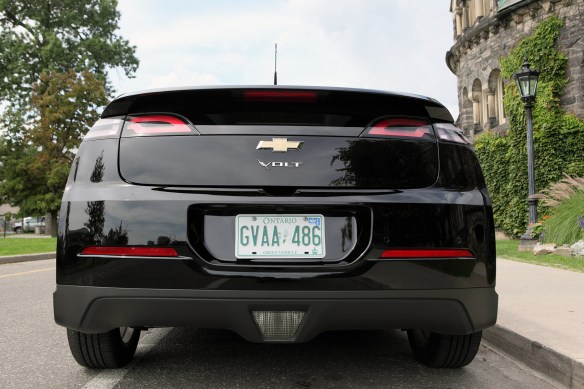
2012 Volt: Eligible for a green licence plate providing access to High Occupancy Vehicle lanes in Ontario, Canada

While braking does feel different in an electric vehicle largely due to the regenerative braking technology, overall the brakes felt as responsive as traditional brakes. And after a few days driving the Volt, the unique characteristics of the regenerative braking became so familiar we were not aware of the difference.

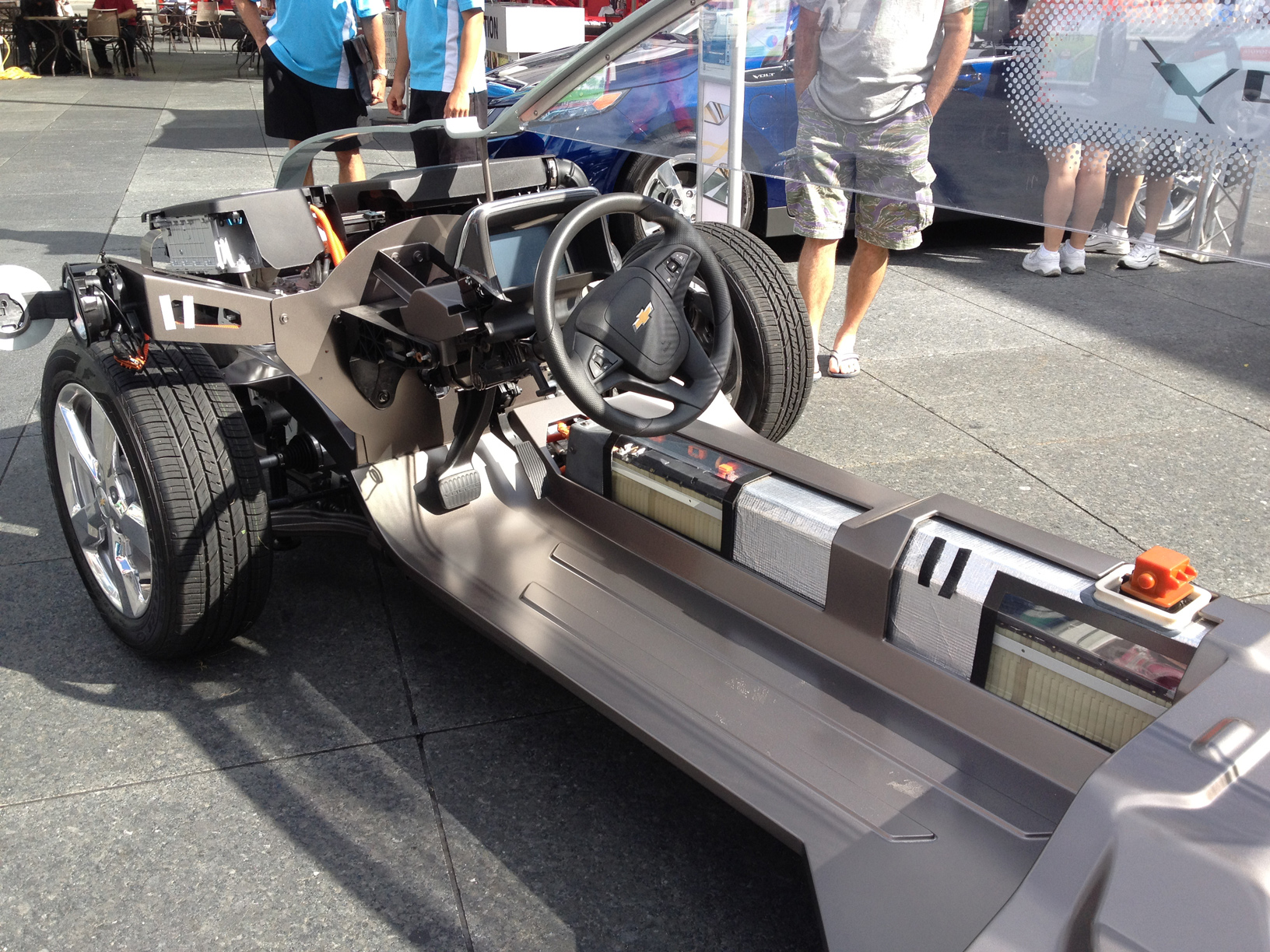
Cut away of the Chevy Volt showing the location of the lithium batteries

As a result of the batteries being located along the bottom of the vehicle (see picture above) the Volt has a low center of gravity and really hugs the road when cornering. Once the electric battery has been depleted the car automatically shifts into ‘range extender’ mode utilizing the gasoline engine. This switch is seamless for the driver and there is only a slight hint of engine sounds once it kicks in, much less overall noise than in a conventional combustion vehicle.

Interior:
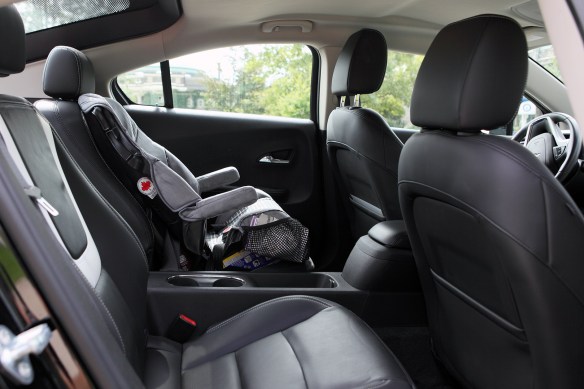
2012 Volt: Rear two person seating

The Volt seats four, as the back middle seat is taken up with the 16 kWh battery. Our Volt tester came with all the available interior features including a premium trim package consisting of leather wrapped steering wheel, heated driver & passenger seats all in a supple black leather. During the test period, we used the Volt around the city for transporting the whole family, including an infant. The installation of the car seat was easy thanks to the UAS and the lack of a middle seat didn’t provide much inconvenience. There was also sufficient trunk space for all the extra ‘stuff’ that comes with transporting young children. However, families with two young kids going on an extended trip may find storage space limited. Similarly, rear leg room is somewhat limited, but legroom and trunk space are largely on par with other compact class vehicles.
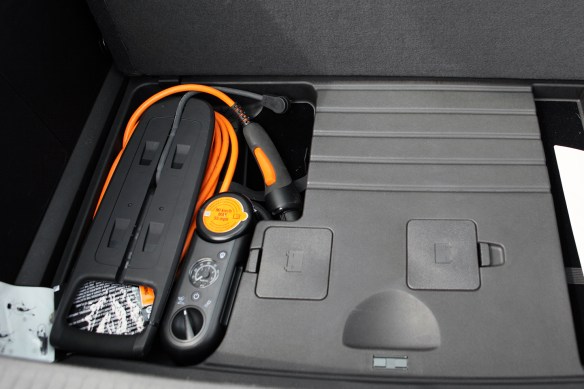
2012 Volt: Location of the Level 1 charger in the trunk along with tire repair kit

The location of the Level 1 (120V) charger under the trunk floor, where a spare tire is typically kept (the vehicle comes with a tire repair kit and air compressor) could be a bit inconvenient on multi-day trips. Since the current design requires you to unload the trunk in order to lift up the trunk floor to access the charger. Having a split trunk floor lid requiring only one side to be free of trunk contents in order to access the charger would likely be a better design.

The infotainment system in the Volt is fairly standard for its class and includes; a 6 speaker system with SiriusXM satellite radio, standard Bluetooth hands free phone and audio connectivity, remote starter, OnStar®, USB ports and an Android and iOS compatible app (OnStar® Remote Link) that provides key vehicle information, including current state of charge.

Optional equipment in the test vehicle included a rear vision camera and parking assist. The parking assist uses ultrasonic frequencies to let you know while backing up when you are nearing an object. A warning symbol also appears in rear view monitor showing what side of the vehicle the object is located, a really nice feature for the urbanite. However, while the rear camera option is a positive feature from a safety perspective, when parking in tight spots, such as a downtown parking garage, the warning beeps can become  distracting and at times we were wanting a mute button. Nevertheless, this is only a minor nuisance and did not significantly detract from the overall driving experience.

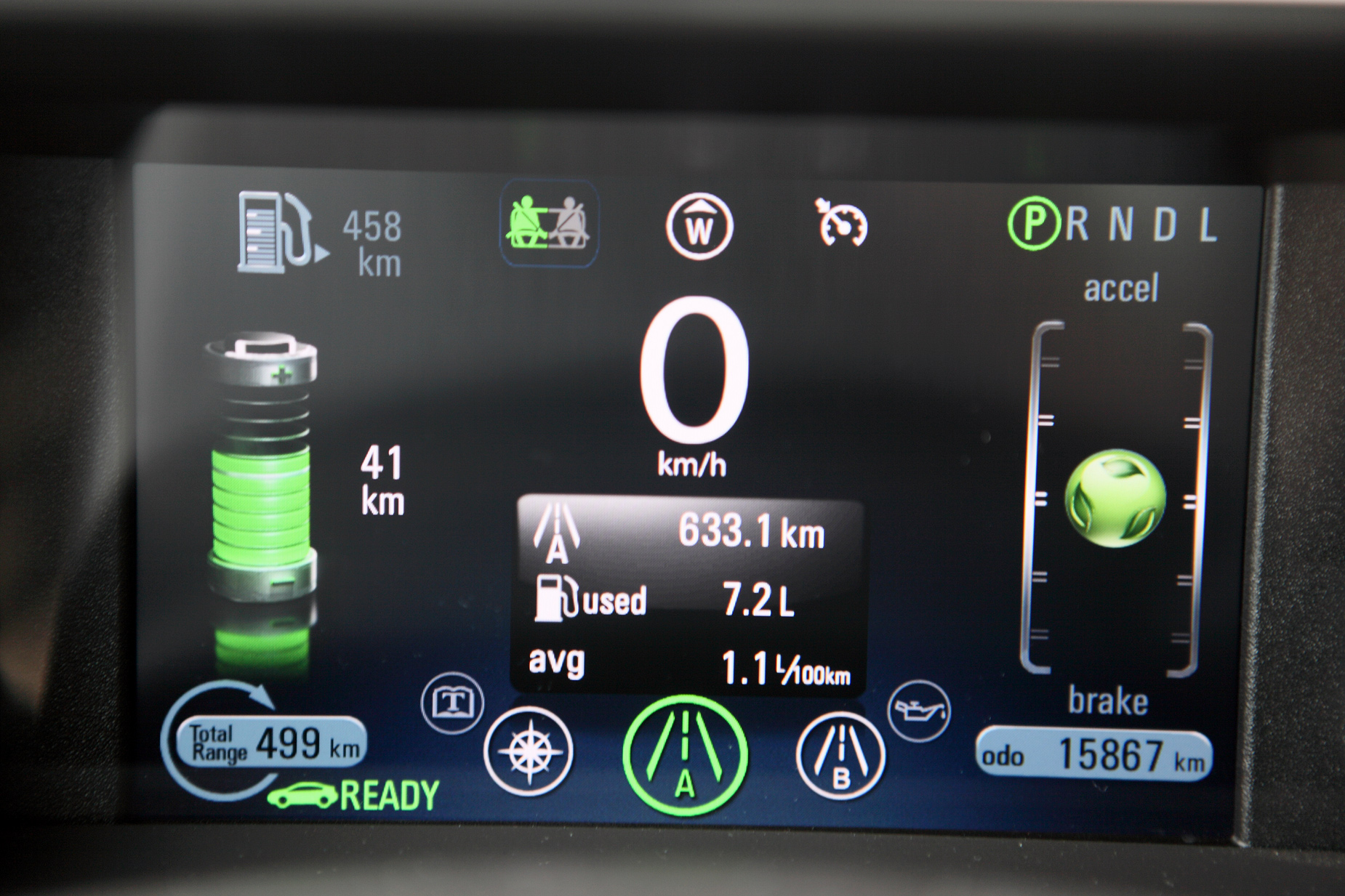
2012 Volt: Dashboard display providing battery, total range and fuel efficiency information. Note the fuel efficiency calculation of 1.1l/100km

For those so inclined, pressing a button on the dash provides a wealth of information on your driving characteristics. There is real time feedback on your driving style in the form of a round green ground ball in the instrument panel that will shift upwards if you are draining energy and stay stable or move downwards if you are recovering energy, through the brakes for example. It can be quite addictive to try and drive in such a manner as to keep the ball steady or move downwards.

Charging (Time and Cost):

The Volt comes with a Level 1 (120 V) charger standard with the vehicle. Plugging the vehicle into to a standard wall socket will charge the 16 kWh battery in approximately 10-12 hours. Volt owners also have the option of upgrading to a Level 2 (240V) charger (think the type of plug your clothes dryer uses) which drops the recharge time down to approximately 4 hours. It should be noted the times are for a completely depleted battery to 100% charge. If you are simply topping up the battery at night charge times would be less. As mentioned previously a fully charged battery will allow you to drive approximately 40 to 80 kilometers. Enough for the average urban commuter to get to work and back, plus perform a few extra side trips along the way.

The cost of recharging the battery will vary based on the electricity prices in the region, but in Ontario, Canada they will range from $1 to $2 depending on the time of day and state of battery charge. The vehicle allows owners to delay their charging to take advantage of time of use billing differences (in jurisdictions that have it). In other words, if an electricity provider reduces their rates starting at 8 pm Volt owners can program their vehicle to start charging after 8 pm despite plugging it in earlier.

Exterior

2012 Volt: Sporty Styling

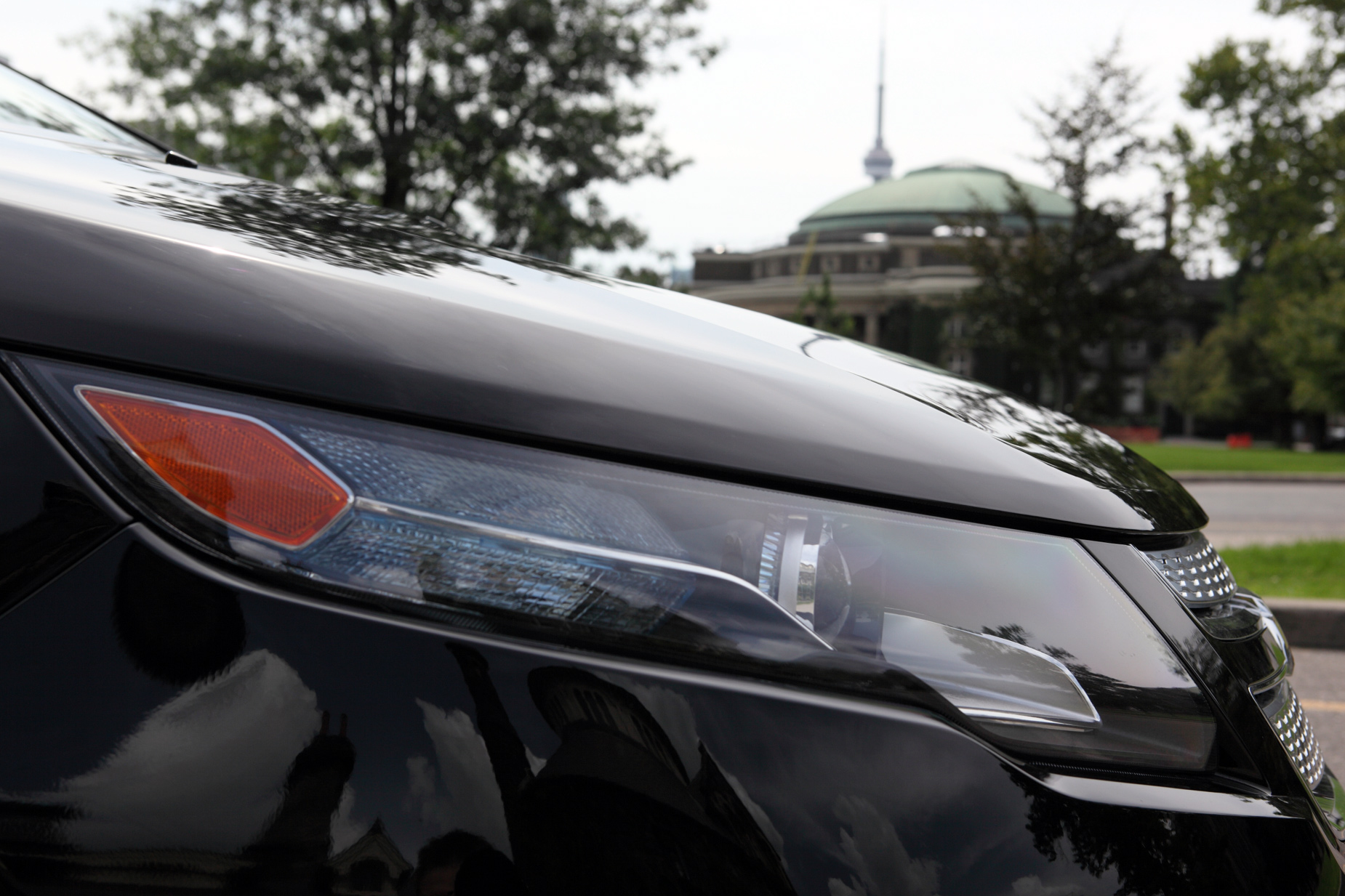
The Volt’s appearance has an understated sportiness to it and the RedlineNorth Team remains partial to the look of the Volt tester in black. Overall, the style of the Volt has a modern look and feel with extremely clean lines and a square back end. The interior trim in the test vehicle was a glossy white plastic and initially it looked attractive, but after a while you felt like you’re riding around in a giant iPod and that look may not be for everyone.

2012 Volt: Front dashboard

Summary

Over the course of the week the RedlineNorth Team test vehicle was recharged three times and used approximately $9 in gasoline (the Volt requires premium gasoline). Total estimated cost for the week based on $1.45/litre ($5.50/gallon) of premium gasoline and 6.5 cents per kilowatt hour of electricity was just under $13.

A number of people have commented that the pay back period on gasoline savings alone on EVs is prohibitively long. Based on gasoline prices only that may be the case depending on the scenario, however, other factors such as reduced maintenance costs, along with non-monetary considerations such as the quiet ride, high low end torque, convenience of filling up at home and peace of mind around reducing your tailpipe emissions all contribute to the attractiveness of the vehicle. Focusing solely on the potential savings from fuel fill ups is a single dimensional argument that misses the point. Consumers that are buying the Volt are buying the total package and its an attractive package at that.

Electric vehicles such as the Volt are remarkable in that they are unremarkable. They feel like you are driving any other similar gasoline or diesel fueled vehicle. The Volt doesn’t feel like you have sacrificed any performance or features for its class in order to be able to drive around town on electrons. Once you get over the type of ‘fuel’ that is powering the vehicle whether it’s diesel, gasoline or electricity you sit back and enjoy the ride.

With GM already selling more than 22,000 Volts to date globally we look forward to seeing more of the Chevy Volts on our roads. So keep your eye out for this innovative, high tech piece of auto machinery as the new 2013 Chevrolet Volt will be arriving in select GM showrooms soon.

Competitors:

Currently in Canada, the main electric vehicle competitors to the Chevrolet Volt are the Nissan Leaf and Mitsubishi Motors’ i-MiEV which are both full battery electric vehicles. The upcoming Ford Focus EV and the plug-in version of the Toyota Prius will also provide the Volt with additional competition later on this year.


If only we had a spare million dollars….

A few months ago, we did a post on celebrity rides and referenced Aerosmith frontman Steven Tyler’s recent purchase of the first production Hennessey Venom GT Spyder model. Well, we thought it was a good time to revisit the Hennessey Venom GT — still the fastest production car on the planet. Hennessey claims the car can achieve a top speed of 272 mph (437 km/h).

Based on a highly modified Lotus Exige chassis, the Venom GT is powered by a twin-turbocharged version of General Motors’ 6.2 L (380 cu in) LS9 V8 from the Chevrolet Corvette C6 ZR1. The modified engine produces 1,200 HP and 1,155 lb-ft. torque. Yes, this is not a typo it produces 1,200 HP! Of course there is a catch though and that’s the price which starts at $1 million USD.

The mid-engine V8 is paired to the rear wheels with a Ricardo 6-speed transmission. The bodywork leverages handmade lightweight carbon fiber along with carbon fiber wheels resulting in a production curb weight of only 2,700 lb (1,200 kg). To deliver the ultimate supercar stopping power required braking components include 15 inch carbon ceramic rotors and Brembo 6-piston calipers in the front and 4-piston calipers in the rear.

However, to truly experience this car you need to watch the following video as pictures just do not do it justice.  The video is of Steven’s actual car as he kindly shared it for a recent episode of Drive’s show Tuned. I guess we all know why he did American Idol now?

Pebble Beach Concours d’Elegance hits sales record

Wow, that’s all we can say about the sales results from last weekend’s Pebble Beach Concours d’Elegance car festival.  The five auction houses that participated in the annual auto festival sold a combined $260 million USD of vehicles last weekend, up 31% from the previous record of $198 million USD set last year, according to Hagerty Insurance, which tracks collector-car prices. The highest price came from Santa Monica based auction house Gooding & Co. when they sold a 1936 Mercedes-Benz 540K Special Roadster for $11.8 million USD.

1936 Mercedes-Benz 540K Special Roadster

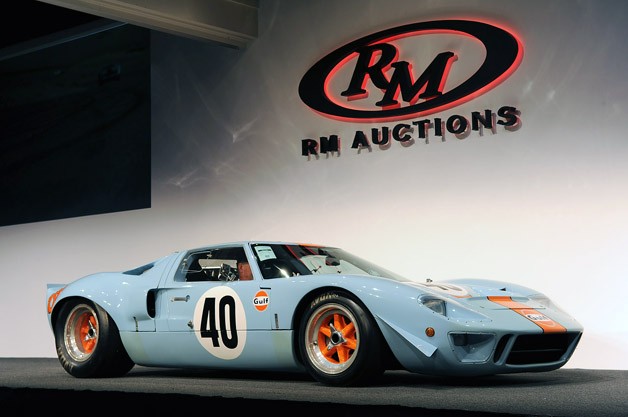
The events second top seller was a 1968 Ford GT40 sold for a record breaking $11 million USD by Blenheim, Ontario’s very own RM Auctions making it the most expensive American car ever sold at auction.

1968 Ford GT40

For more photos check out the following Globe and Mail slide show of the event.

Consumer Reports: Total Cost of Car Ownership

Consumer Reports have recently published an analysis on the total cost of ownership of a new vehicle over a one, three, five and eight year period.  They have used a number of factors in their analysis including depreciation, fuel, interest on financing, insurance, sales tax, as well as average maintenance and repair costs.

Their analysis has produced some interesting results.  First and foremost the median cost of ownership for a new vehicle is more than $9,100 a year, over a five year ownership period.  Furthermore, the largest single cost in a new vehicle is depreciation, making up 48% of costs in the first five years. This of course assumes that you will be eventually selling the new vehicle down the road and not driving it into the ground.

Consumer Reports Analysis

Courtesy: Consumer Reports.org

The second largest cost is fuel accounting for 24%, while interest on vehicle financing is third with 11%, again over a five year period.

As indicated at the beginning of this post the Consumer Reports analysis is based on a number of assumptions, such as the cost of fuel ($4.20/gallon or $1.11/litre), insurance, interest (6%, 15% down, 5 years – also assumes the vehicle isn’t bought outright at the beginning) and sales tax (5%) to name a few.

All of their assumptions are reasonable and necessary for a broad based analysis, but can vary widely across different jurisdictions. One should keep this in mind when reading the results.

Nonetheless, based on their analysis, the least expensive car to own is Toyota Prius which costs just $5,000 a year to own for five years.  While the most expensive vehicle in the list is the BMW 750Li at a whopping $21,500 a year, for a five year period.

A complete breakdown on the ownership cost per model can be found below.

For a more in depth analysis, including further details on the assumptions used and how that may relate to your situation read the complete article here.

Ownership Costs by Vehicle
(Source: Consumer Reports)

Lowest cost Highest cost
Make & Model Cost/year over 5 years Make & model Cost/year over 5 years
Small cars
Toyota Prius C $5,000 Mitsubishi Lancer ES $7,000
Toyota Corolla Base 5,250 Mazda3 Hatchback 7,000
Honda Fit (base) 5,250 Nissan Sentra 2.0 SL 7,000
Smart ForTwo 5,500 Ford Focus Hatchback 7,000
Honda Fit Sport 5,500 Kia Soul 7,000
Mazda2 (MT) 5,500 Kia Forte Hatchback 7,000
Scion xD (MT) 5,500 Kia Forte Koup 7,250
Toyota Yaris Hatchback 5,500 Chevrolet Cruze 1.4T 7,250
Scion xD (AT) 5,750 Suzuki SX4 Hatchback 7,500
Toyota Corolla LE 5,750 Chevrolet Cruze ECO 7,500
Family sedans
Toyota Camry Hybrid 6,500 Toyota Camry (V6) 8,250
Volkswagen Passat TDI 6,500 Ford Fusion (V6, FWD) 8,250
Toyota Camry (4-cyl.) 6,750 Chevrolet Impala (3.6) 8,250
Hyundai Sonata Hybrid 6,750 Nissan Altima (V6) 8,500
Hyundai Sonata (2.4) 6,750 Subaru Legacy 3.6R 8,500
Honda Accord (4-cyl.) 6,750 Chrysler 200 (V6) 8,500
Ford Fusion (4-cyl.) 7,000 Kia Optima 2.0T 8,750
Mazda6 (4-cyl.) 7,000 Ford Fusion (V6, AWD) 8,750
Nissan Altima (4-cyl.) 7,250 Mazda6 (V6) 9,000
Subaru Legacy 2.5i 7,250 Volkswagen Passat (V6) 9,250
Upscale & luxury cars
Lexus CT 200h 7,750 Lincoln MKS AWD 13,000
Buick Verano (2.4) 7,750 BMW 535i 13,250
Audi A3 2.0T 8,000 Mercedes-Benz E350 13,500
Buick Regal (2.4) 8,000 Jaguar XF 13,500
Acura TSX (4-cyl.) 8,250 Hyundai Equus 14,000
Buick Regal (turbo) 8,500 Lexus LS 460L 16,000
Buick LaCrosse eAssist 8,750 Jaguar XJL 19,000
Infiniti G25 Sedan 9,000 Audi A8 L 20,000
Toyota Avalon 9,000 Mercedes-Benz S550 20,500
Volkswagen CC 2.0T 9,000 BMW 750Li 21,500
Lowest cost Highest cost
Make & Model Cost/year over 5 years Make & model Cost/year over 5 years
Small SUVs
Toyota RAV4 (4-cyl.) $7,000 Subaru Forester 2.5XT (turbo) $8,250
Honda CR-V 7,250 Nissan Xterra 8,750
Nissan Juke 7,250 Mitsubishi Outlander (V6) 9,000
Mitsubishi Outlander (4-cyl.) 7,500 Kia Sportage (2.0T) 9,250
Hyundai Tucson (2.4) 7,500 Volkswagen Tiguan 9,750
Midsized SUVs
Hyundai Santa Fe (4-cyl.) 8,000 Dodge Journey V6) 10,750
Chevrolet Equinox (4-cyl.) 8,000 Nissan Pathfinder (V6) 10,750
GMC Terrain (4-cyl.) 8,000 Ford Explorer (V6) 11,250
Kia Sorento (4-cyl.) 8,250 Jeep Grand Cherokee (V6) 11,250
Jeep Liberty 8,500 Jeep Grand Cherokee (V8) 12,750
Large SUVs
Ford Flex (V6) 10,500 Dodge Durango (V8) 13,500
GMC Acadia 10,500 Ford Expedition 14,000
Chevrolet Traverse 10,500 Chevrolet Suburban 14,000
Ford Flex (EcoBoost, V6) 11,750 GMC Yukon XL 14,250
Dodge Durango (V6) 12,250 GMC Yukon (5.3) 15,000
Upscale/luxury SUVs
BMW X3 (3.0) 10,250 Mercedes-Benz ML350 14,250
Land Rover LR2 10,500 Land Rover LR4 14,250
Infiniti EX 10,500 Mercedes-Benz GL350 BlueTec 15,000
Audi Q5 3.2 11,250 Porsche Cayenne (V6) 15,250
Lexus RX 350 11,250 Infiniti QX56 15,500
Buick Enclave 11,250 Lincoln Navigator 15,750
Volvo XC60 11,500 Toyota Land Cruiser 16,000
Mercedes-Benz GLK350 11,500 Land Rover Range Rover Sport 16,250
Land Rover Range Rover Evoque 11,500 Mercedes-Benz GL450 16,500
Acura MDX 11,750 Cadillac Escalade (base) 17,250
Lowest cost Highest cost
Make & Model Cost/year over 5 years Make & model Cost/year over 5 years
Minivans & wagons
Toyota Prius V $6,000 BMW 328xi Wagon $10,000
Volkswagen Jetta Wagon TDI 6,250 Dodge Grand Caravan SXT 10,250
Volkswagen Jetta Wagon SE 7,500 Kia Sedona 10,500
Mazda5 7,750 Nissan Quest 10,500
Subaru Outback 2.5i 8,000 Chrysler Town & Country 10,750
Sporty cars & convertibles
Mini Cooper Hatchback Base 5,750 Lexus IS 250 Convertible 11,000
Honda CR-Z 6,000 Subaru Impreza STi 11,000
Fiat 500 Sport 6,000 Chevrolet Camaro Convertible SS 11,000
Volkswagen Beetle 2.5 6,500 Mitsubishi Lancer Evolution 11,250
Fiat 500 C 6,500 BMW 328i Convertible 11,750
Mini Cooper Hatchback S 6,500 Audi A5 2.0T 11,750
Scion tC 6,500 Infiniti G37 Convertible 11,750
Hyundai Veloster 6,750 Chevrolet Corvette Base 12,750
Kia Forte Sedan 6,750 Chevrolet Corvette Z06 14,500
Honda Civic Si 7,250 Jaguar XK 19,000
Pickup trucks
Toyota Tacoma (V6) 8,500 Chevrolet Avalanche 13,000
Chevrolet Colorado 9,250 Dodge Ram 2500 Turbodiesel 13,750
Nissan Frontier 9,250 Ford F-250 Turbodiesel 14,000
GMC Canyon 9,500 GMC Sierra 2500HD Turbodiesel 14,250
Honda Ridgeline 9,500 Chevrolet Silverado 2500HD Turbodiesel 14,25

Moparfest 2012

During a glorious recent August weekend, Team RedlineNorth headed down to Southwestern Ontario’s Moparfest. With close to 2,000 show vehicles and almost 25,000 spectators Moparfest is now Canada’s largest all Mopar show and is a sight to be experienced for any car enthusiast. Started 32 years ago by a few friends with a shared love of Mopar cars the show has grown into a massive charity event that takes over the town of New Hamburg, Ontario for one weekend a year.  The annual event is a fundraiser for the local community with proceeds totaling over $2.5 million dollars from the past 32 years.
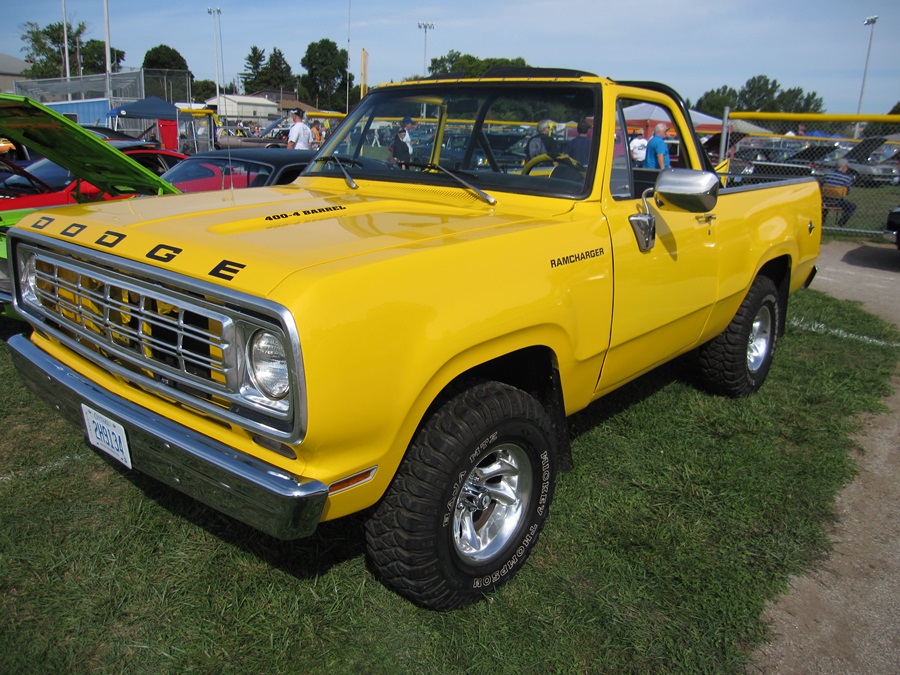
Here are some amazing new and old examples of Mopar muscle and design in all their automotive glory.

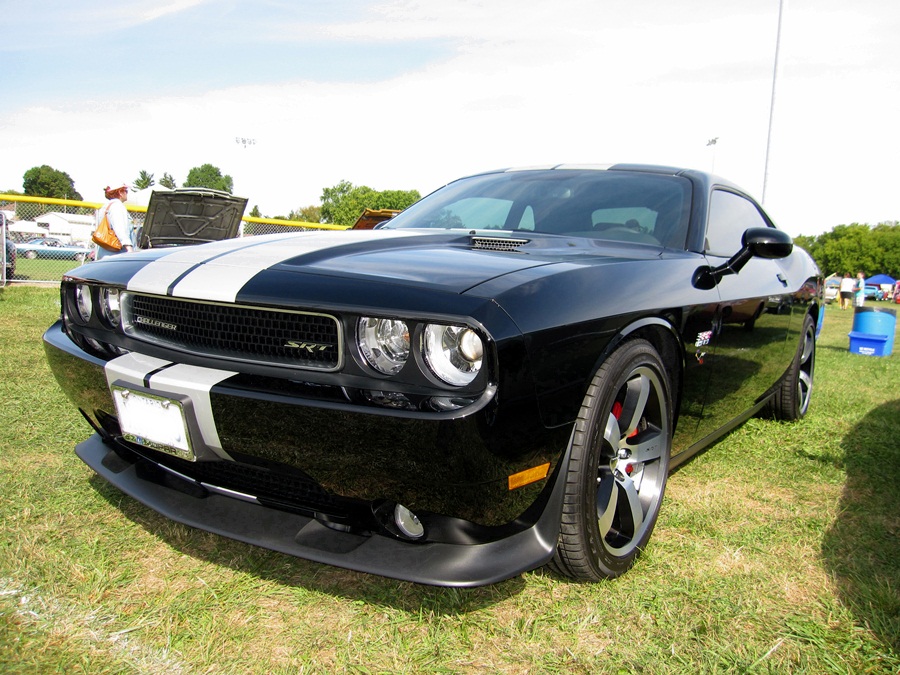
2012 Dodge Challenger SRT

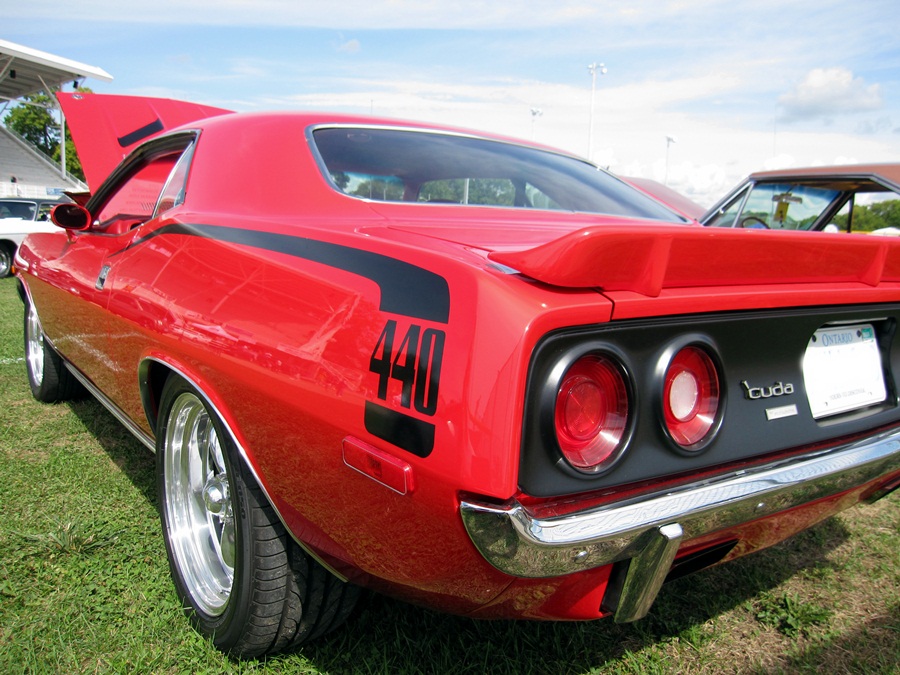
1970 Hemi Cuda

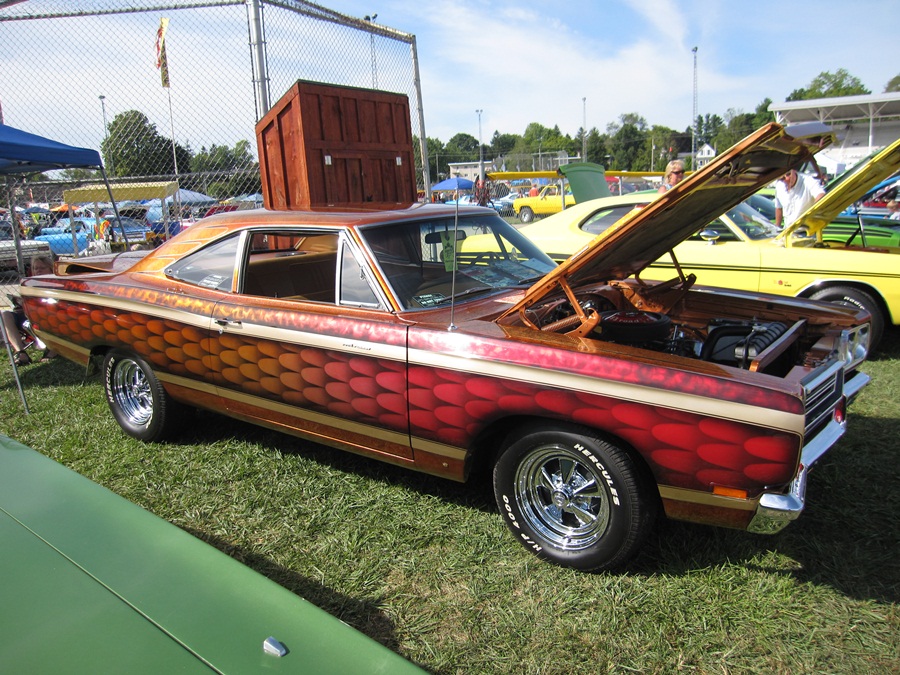
1969 AMC AMX

2012 Dodge Challenger SRT8 – Car competed in 2011 Targa Newfoundland Rally

Desotos lined-up

1940s Dodge Heavy Duty

1969 Dodge Coronet

1980 Dodge Ramcharger

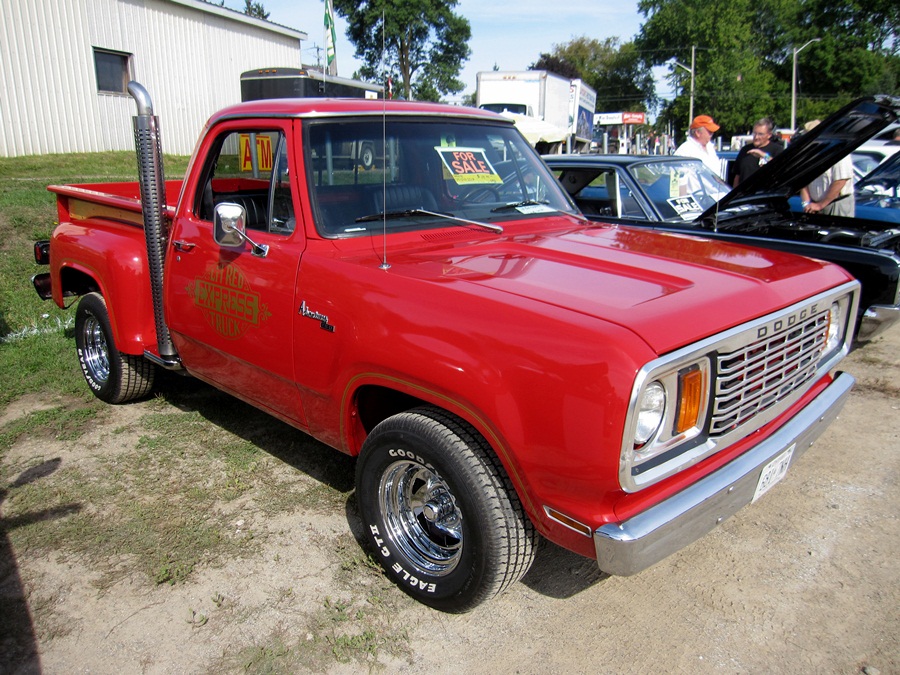
1978 Dodge Lil’ Red Express

1980 Chrysler Cordoba

The majority of the show consisted of 60s/70s muscle car models including the Barracuda, Dodge Charger, Dart, Swinger, Duster, Plymouth Road Runner, Plymouth Super Bee, Plymouth Satellite and a few rare Superbird models. In addition, there were a wide range of Fargo trucks as well as luxury sedans including the Chrysler Cordoba and New Yorker models with a few jeeps and AMC cars in between. All in all, an amazing showcase put on right here in the heartland of Ontario.  Who knew there was so much Mopar pride north of the border?

Wheels on the Danforth

True to our roots of covering local events, the RedlineNorth team dropped into a Toronto car show called Wheels on the Danforth on Saturday, August 11th. Hosted by the Crossroads of the Danforth BIA which is made up of the businesses and property owners on Danforth Ave. between Victoria Park Avenue and Scotia Road (just east of Warden Avenue).

1968 Dodge Charger

Unfortunately, it rained throughout the day so overall turnout of classic cars was far lower than last year’s 200. Nevertheless, there was an assortment of 60s muscle, 40s-50s classics and a few Hot Rods in between.

1968 Ford Torino GT

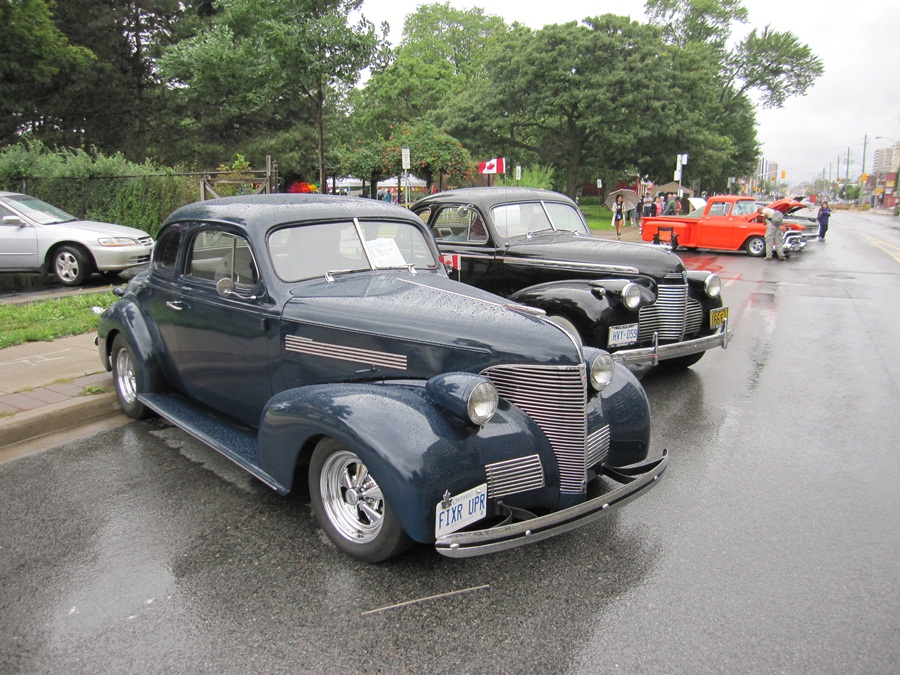
40s Ford Business Coupes

1957 Chevrolet Bel Air 2 Door Hardtop

1957 GMC Pick-Up

Boyd Coddington style Hot Rod Convertible

Pikes Peak Crash

Pikes Peak is a fourteen thousand foot peak in the United States, located 10 miles (16 km) west of the city of Colorado Springs.  It is also the location of the Pikes Peak International Hill Climb, an annual automobile and motorcycle hill climb to the summit. The elevation climbs from 4,720 ft (1,440 m) from the start to the finish at 14,110 ft (4,300 m), on grades averaging 7%.  Of course what goes up must come down, as driver Jeremy Foley and his co-driver found out a couple of days ago around mile 16 in an area of the mountain known as Devil’s Playground.

Their Mitsubishi EVO VIII flipped numerous times as it rolled down the hill in what could be misconstrued as Hollywood stunt. Thankfully both were not seriously hurt in the crash.